
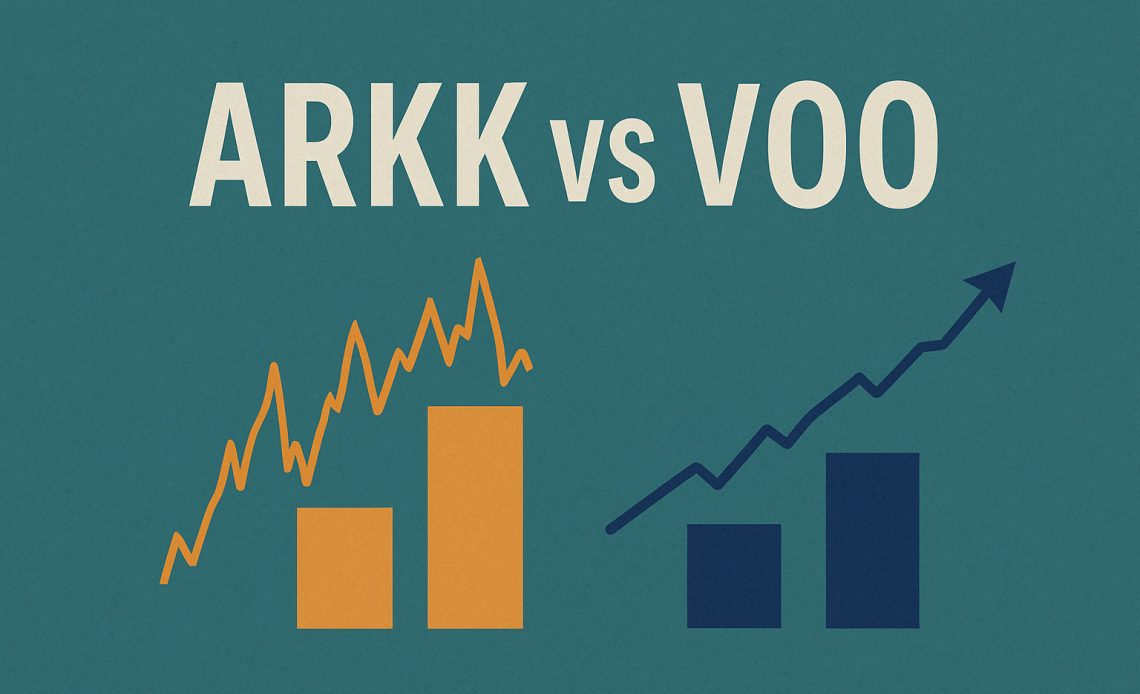
ARKK vs VOO: High-Growth Bets or Steady Market Returns?
Description
Investors choosing between ARKK and VOO face a fundamental question: do you chase disruptive innovation or stay the course with the broader market? ARKK, managed by Cathie Wood, targets high-growth tech companies with bold visions. VOO, on the other hand, mirrors the S&P 500 and offers low-cost, market-wide exposure. This guide compares their strategies, performance, risks, fees, and suitability to help you make an informed decision based on your financial goals.
Introduction
Growth or stability?
Moonshots or blue chips?
The decision between ARKK (ARK Innovation ETF) and VOO (Vanguard S&P 500 ETF) represents more than just two tickers—it’s a clash of philosophies.
One is a bold, high-conviction bet on the future of innovation.
The other is a reliable, low-cost foundation of the American economy.
In this guide, we’ll compare ARKK vs VOO across the dimensions that matter—strategy, holdings, performance, volatility, fees, and investor fit—to help you decide which belongs in your portfolio (or if you should own both).
Overview: What Are ARKK and VOO?
ARKK: ARK Innovation ETF
- Managed by Cathie Wood of ARK Invest
- Focuses on “disruptive innovation”
- Actively managed
- Heavy exposure to tech, genomics, AI, fintech
- High volatility and turnover
- Expense ratio: 0.75%
- Launched in 2014
VOO: Vanguard S&P 500 ETF
- Passively tracks the S&P 500
- Contains 500 largest U.S. public companies
- Ultra-low cost
- Highly diversified and stable
- Expense ratio: 0.03%
- Launched in 2010
Investment Strategy
ARKK Strategy
- Actively managed thematic ETF
- Concentrated portfolio (~35–55 stocks)
- Emphasizes innovation: electric vehicles, DNA sequencing, robotics, AI, etc.
- Manager conviction plays a big role in stock selection
- High portfolio turnover
ARKK invests in the future—even if that future is uncertain and volatile.
VOO Strategy
- Passively managed index ETF
- Broad exposure across sectors: tech, healthcare, finance, consumer goods
- Market-cap weighted
- Minimal turnover, rebalanced quarterly
- Focuses on market-matching returns
VOO doesn’t try to beat the market—it is the market.
Top Holdings
| Rank | ARKK Top Holdings | Weight | VOO Top Holdings | Weight |
|---|---|---|---|---|
| 1 | Tesla (TSLA) | ~9% | Apple (AAPL) | ~7% |
| 2 | Roku (ROKU) | ~6% | Microsoft (MSFT) | ~7% |
| 3 | Zoom Video (ZM) | ~5% | Amazon (AMZN) | ~3% |
| 4 | Exact Sciences (EXAS) | ~4% | Nvidia (NVDA) | ~3% |
| 5 | CRISPR Therapeutics (CRSP) | ~4% | Alphabet (GOOGL/GOOG) | ~4% total |
ARKK is tech-heavy but concentrated, while VOO is diversified and stable.
Performance Comparison
| Period | ARKK Total Return | VOO Total Return |
|---|---|---|
| 2020 (Bull) | +153% | +18% |
| 2021 | -23% | +26% |
| 2022 (Bear) | -67% | -18% |
| 2023 | +42% | +26% |
| 5-Year CAGR | ~5–8% | ~12% |
ARKK shines in speculative bull markets, but crashes hard during downturns.
Volatility and Risk
- ARKK has a standard deviation over 40%, making it one of the most volatile ETFs
- VOO has a standard deviation closer to 18%, with far lower drawdowns
- ARKK’s max drawdown (2021–2022): -76%
- VOO’s max drawdown during same period: -24%
Beta Comparison (vs S&P 500):
- ARKK Beta: ~1.60–2.00
- VOO Beta: ~1.00
If you can’t stomach deep drawdowns, ARKK may not be for you.
Expense Ratios and Fees
| ETF | Expense Ratio | Turnover Rate |
|---|---|---|
| ARKK | 0.75% | ~70–90% |
| VOO | 0.03% | <5% |
ARKK’s fees are much higher due to active management—but also due to research, innovation focus, and higher trading.
Over decades, this cost difference can significantly impact net returns.
Ideal Investor Profiles
ARKK May Be Right If:
- You believe in disruptive innovation
- You’re comfortable with high volatility
- You have a long time horizon (10+ years)
- You want satellite exposure in a core portfolio
VOO May Be Right If:
- You want market exposure with minimal cost
- You value diversification and stability
- You’re investing for retirement or FIRE
- You want a solid core holding in your portfolio
Pros and Cons
✅ ARKK Pros
- Potential for explosive returns
- Exposure to high-growth industries
- Actively managed innovation lens
- High risk = high reward (in right cycle)
⚠️ ARKK Cons
- Extremely volatile
- Heavily concentrated
- Underperformance risk in bear markets
- Higher fees
✅ VOO Pros
- Low cost
- Time-tested, diversified
- Easy to hold long-term
- Suitable for all risk profiles
⚠️ VOO Cons
- No chance to “beat” the market
- Includes underperforming companies by default
- Less exciting—“boring” strategy
Can You Own Both?
Yes. Many investors build a core-and-satellite strategy:
- Core (80–90%): VOO or total market ETFs
- Satellite (10–20%): Thematic ETFs like ARKK
This way, you enjoy the stability of the market while still getting a shot at alpha from disruptive innovation.
Tax Considerations
Both ARKK and VOO are ETFs, meaning they benefit from:
- Tax-efficient structure
- Lower capital gains distributions
- Ideal for taxable brokerage accounts
However, ARKK’s higher turnover can occasionally trigger gains—so it’s often best held in tax-advantaged accounts like Roth IRAs if you’re concerned.
Conclusion: Innovation or Index?
Choosing between ARKK and VOO depends on your personality as much as your portfolio goals.
- If you love big ideas and have high risk tolerance, ARKK can offer a thrill ride with long-term upside.
- If you prefer steady wealth-building with minimal drama, VOO is hard to beat.
- And if you’re pragmatic, maybe you just buy both—in the right proportion.
Markets change. Innovation cycles rotate. But time, discipline, and allocation still matter more than headlines.
Related Keywords
- ARKK vs VOO
- ARK Innovation ETF vs S&P 500
- Cathie Wood ETF comparison
- VOO long-term performance
- ARKK volatility explained
- ARKK returns vs SPY
- High growth ETF vs index ETF
- ARKK holdings breakdown
- VOO vs QQQ vs ARKK
- Innovation ETF vs broad market ETF
- ARKK historical drawdowns
- VOO low cost index fund
- Best ETFs for long-term growth
- Active ETF vs passive ETF
- VOO vs ARKK tax efficiency
- ETF investing strategies
- ARKK for retirement portfolio
- How to use ARKK in portfolio
- Core satellite investing with ETFs
