
Definition
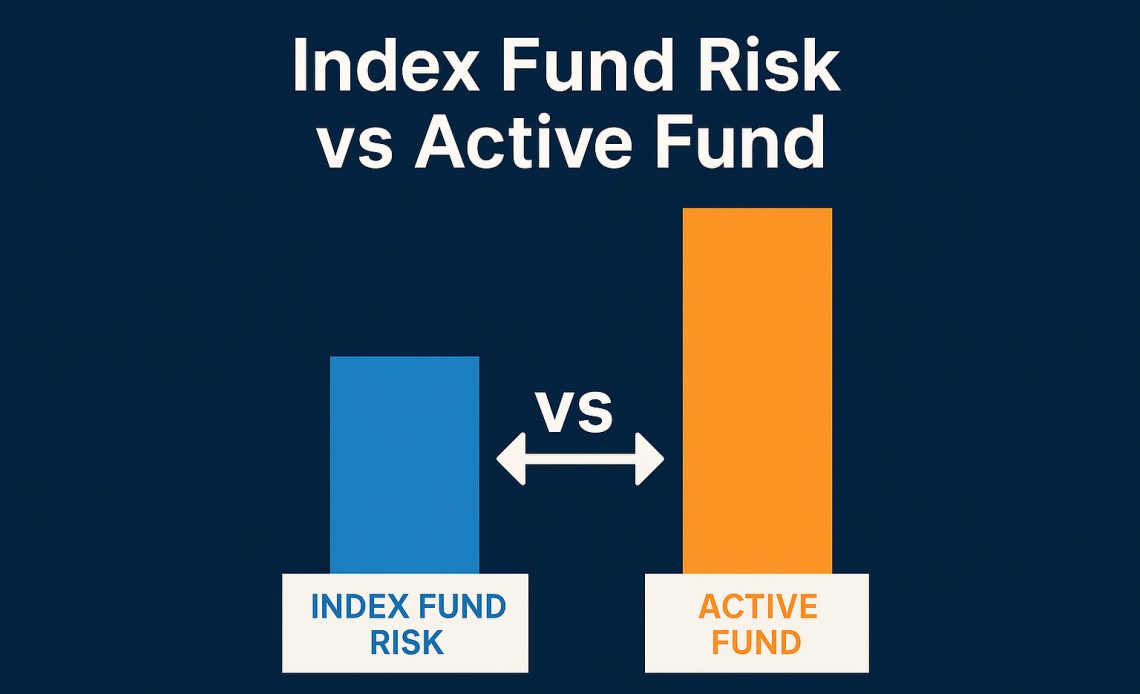
When comparing index funds and actively managed funds, the question of risk becomes central to evaluating which strategy aligns with an investor’s goals. While index funds aim to mirror the performance of a market index, active funds try to outperform it through strategic selection and timing.
However, this distinction comes with different types and levels of risk. Index funds offer market risk but less manager risk, while active funds introduce decision-making risk, performance variability, and often higher fees.
Understanding the risk profile of each is essential to building a portfolio that aligns with your investment horizon, goals, and risk tolerance.
Types of Risk: Index vs Active
Let’s break down the different types of risks investors face in both types of funds:
| Type of Risk | Index Funds | Active Funds |
|---|---|---|
| Market Risk | ✅ Yes (direct exposure) | ✅ Yes (still exposed to markets) |
| Manager Risk | ❌ No (no discretion involved) | ✅ Yes (depends on manager skill) |
| Tracking Error Risk | ✅ Low | ❌ Not applicable (no benchmark tracking) |
| Style Drift Risk | ❌ No (rule-based strategy) | ✅ Yes (manager may change strategy) |
| Concentration Risk | Depends on index | Manager’s discretion (can be high) |
| Fee Risk | ✅ Very low | ❌ Higher fees reduce returns |
| Underperformance Risk | ✅ Underperforms by fees only | ✅ High potential for lagging index |
How Index Funds Work (Risk Context)
Index funds track a market benchmark, such as:
- S&P 500 (large-cap U.S. stocks)
- Russell 2000 (small-cap U.S. stocks)
- MSCI World (global developed markets)
They hold all or most of the securities in the index. This passive strategy:
- Guarantees market returns minus a small fee
- Eliminates stock selection and timing errors
- Does not protect against downturns (you ride the full market cycle)
Risks:
- You will lose money in bear markets
- Heavy sector weightings (e.g., tech in the S&P 500) may increase volatility
- No ability to adjust for market conditions
How Active Funds Work (Risk Context)
Active funds are run by portfolio managers who:
- Buy and sell securities based on research, forecasts, and models
- May focus on outperforming a benchmark or delivering absolute returns
- Have the flexibility to shift between sectors, cash, and asset classes
Risks:
- Fund may underperform the market — and often does
- Manager’s decisions can backfire
- Higher turnover can increase transaction costs and taxes
- Style drift (changing from growth to value or vice versa) can confuse investors
- Fees are significantly higher (0.5%–2.0%+)
Statistical Insights: Which Is Riskier?
Historical Data (From SPIVA & Morningstar Reports):
- Over a 10-year period, 80%–90% of active funds underperform their index benchmarks net of fees.
- Active funds show higher standard deviation (volatility) and greater drawdown in bear markets unless they hold large cash positions.
Example:
| Fund Type | Average Expense Ratio | 10-Year Outperformance Rate | Standard Deviation |
|---|---|---|---|
| Index Fund (S&P 500) | 0.04% | N/A (benchmarked) | ~15% |
| Active Large-Cap Fund | 0.85% | ~15% | ~17%–20% |
Use Case Scenarios
Scenario 1: Long-Term Retirement Investor
- Jane invests in a Total Market Index Fund for her 30-year retirement plan.
- She accepts market risk but avoids active manager fees and misjudgments.
- Her risk exposure is tied to the economy, not human decision-making.
✅ Index fund is lower-risk in the long run due to predictable structure and low cost.
Scenario 2: Tactical Investor Seeking Alpha
- Mark wants to outperform the market by using a fund that rotates between sectors based on macro trends.
- He chooses an active global equity fund with a good recent track record.
⚠️ Mark accepts manager risk, and his fund may suffer if the macro calls are wrong or the strategy changes.
Scenario 3: Downturn Hedge Seeker
- Lisa is concerned about recessions. She picks an active bond fund that can move into cash or defensive positions.
- In a downturn, her fund loses less than an index-tracking bond ETF.
✅ Active fund may offer better downside protection, but only if the manager is skilled.
Cost as a Risk Factor
The expense ratio isn’t just a fee — it’s a form of structural risk because:
- It reduces net returns regardless of market performance
- Over decades, high fees compound into significant underperformance
- Index funds, with fees as low as 0.03%, reduce this “fee risk” substantially
Transparency & Control
| Factor | Index Fund | Active Fund |
|---|---|---|
| Daily Holdings Disclosure | ✅ Yes (ETFs) / ✅ Yes (mutual funds) | ❌ Often delayed / quarterly disclosure |
| Strategy Stability | ✅ Fixed index | ❌ May shift over time |
| Predictability | ✅ Very high | ❌ Depends on manager |
Related Terms
- Market Risk – The risk of loss due to market-wide downturns.
- Manager Risk – The chance that a fund manager’s decisions will harm performance.
- Tracking Error – Deviation between a fund’s returns and its benchmark.
- Standard Deviation – A measure of volatility (risk).
- Sharpe Ratio – Risk-adjusted return per unit of volatility.
- Expense Ratio – Annual cost of managing the fund, expressed as a percentage.
- Alpha – The excess return an active fund generates over its benchmark.
Summary: Risk Comparison
| Feature | Index Fund | Active Fund |
|---|---|---|
| Market Risk | ✅ Yes | ✅ Yes |
| Manager Risk | ❌ No | ✅ Yes |
| Predictability | ✅ High | ❌ Low to Medium |
| Fees | ✅ Low (0.03%–0.10%) | ❌ Higher (0.50%–2.00%+) |
| Volatility | ✅ Matches index | ❌ May be higher or lower |
| Underperformance Potential | ✅ Slight (by fees) | ✅ Significant (and common) |
| Outperformance Potential | ❌ None | ✅ Possible (but rare and inconsistent) |
Conclusion
When it comes to risk, index funds and active funds differ not in whether they are risky — both are — but in what kinds of risks they carry.
✅ Index funds offer:
- Market risk, but very little else
- Predictability
- Transparency
- Low costs that enhance compounding
⚠️ Active funds offer:
- Potential for outperformance
- But also higher risk of failure
- Dependency on manager skill
- Greater volatility and costs
For most long-term investors, especially those focused on wealth building, retirement, or minimizing fees, index funds present a more controlled and efficient risk environment. Active funds may make sense for niche strategies or risk-tolerant investors, but they demand vigilance, due diligence, and humility.
