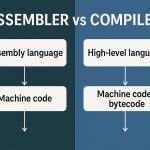
What Is a Disassembler?
A disassembler is a specialized software tool or algorithm that converts machine code (binary instructions executed by a computer’s CPU) back into assembly language, which is more readable and human-interpretable. Unlike a decompiler, which attempts to recreate high-level source code, a disassembler operates one level lower, providing a direct representation of binary instructions.
In essence, if you feed an executable program into a disassembler, it will break down the binary and translate it into the corresponding assembly language instructions such as MOV, JMP, CALL, or PUSH. This is extremely useful for reverse engineering, security analysis, debugging, and forensics.
Why Are Disassemblers Important?
Disassemblers are critical tools in many technical fields, especially where source code is unavailable. They play a vital role in:
- Reverse Engineering: Analyzing proprietary software, malware, or firmware to understand how it works.
- Security Audits: Inspecting binaries for vulnerabilities like buffer overflows or backdoors.
- Debugging and Optimization: Understanding compiler-generated assembly code to trace bugs or improve performance.
- Software Cracking and DRM Circumvention: Although often illegal or unethical, disassemblers are used in hacking tools.
- Educational Use: Teaching low-level programming, instruction sets, and computer architecture.
How Does a Disassembler Work?
A disassembler operates by taking binary machine code as input and producing a corresponding assembly language listing as output. The process involves:
- Reading Binary Files: It loads
.exe,.dll,.bin, or firmware files into memory. - Instruction Decoding: It uses the processor’s instruction set to match binary opcodes to assembly mnemonics.
- Address and Offset Handling: It assigns labels or comments to jumps and calls.
- Symbol Resolution (if available): With debug info or symbol tables, it names functions or variables.
- Output Generation: A readable disassembly file is produced, often in Intel or AT&T syntax.
The output might look like:
00401000 55             push ebp
00401001 8BEC           mov ebp, esp
00401003 83EC 0C        sub esp, 0Ch
00401006 C745 FC 00...  mov [ebp-4], 0
Types of Disassemblers
Disassemblers come in a variety of forms, each suited to different purposes and user needs. Broadly, they can be classified as:
1. Linear Sweep Disassembler
This is the simplest type of disassembler. It reads the binary file from start to end, decoding instructions sequentially. However, it may misinterpret data embedded within code (e.g., jump tables or strings) as valid instructions.
- Pros: Fast and simple
- Cons: Less accurate, especially with obfuscated or optimized code
2. Recursive Descent Disassembler
This approach follows control flow paths (like branches and jumps) to disassemble only reachable code, skipping over embedded data.
- Pros: More accurate in separating code and data
- Cons: May miss unreachable code or special control flow tricks
3. Hybrid Disassembler
Combines both linear and recursive techniques. Some tools use pattern recognition, heuristics, or even symbolic execution to improve decoding accuracy.
Common Architectures Supported
Modern disassemblers support a wide range of CPU architectures, each with its own instruction set. Some of the most common ones include:
- x86 / x86-64: Intel and AMD-based architectures for PCs and servers.
- ARM / ARM64: Used in smartphones, tablets, and IoT devices.
- MIPS: Common in embedded systems.
- RISC-V: A rising open-source architecture.
- PowerPC: Used in older Macs and game consoles.
- SPARC: Sun Microsystems architecture used in high-end servers.
A quality disassembler will allow the user to choose or detect the correct architecture.
Popular Disassembler Tools
Here are some of the most widely used disassemblers in the industry:
1. IDA Pro (Interactive DisAssembler)
- The gold standard for professional reverse engineering.
- Supports graph views, scripting, plugin architecture.
- Expensive, but powerful.
2. Ghidra
- Developed by the NSA, open-source and free.
- Includes both disassembly and decompilation.
- Feature-rich and actively maintained.
3. Radare2
- Free and open-source.
- Powerful CLI, supports scripting and visual modes.
- Has a steep learning curve.
4. objdump
- Comes with GNU binutils.
- Simple command-line tool for dumping assembly from binaries.
- Suitable for quick tasks or automated workflows.
5. Hopper
- Affordable commercial alternative to IDA for macOS and Linux.
- User-friendly GUI.
Disassembler vs Decompiler
Although often confused, these two tools serve different purposes:
| Feature | Disassembler | Decompiler |
|---|---|---|
| Output | Assembly Language | High-level Language (e.g. C/C++) |
| Use Case | Reverse engineering, debugging | Code analysis, source recovery |
| Accuracy | Very accurate | Approximate, depends on heuristics |
| Output Readable? | For experts | More readable for general developers |
While disassemblers are more “faithful” to the binary’s actual instructions, decompilers try to infer control structures like loops, conditions, and function calls, which makes them more intuitive but less exact.
Applications of Disassemblers
Disassemblers serve a wide variety of use cases across industries. Here are some of the most significant ones:
1. Malware Analysis
Security researchers use disassemblers to inspect how malware operates. Since most malware is distributed in compiled form (without source code), disassembly helps analysts:
- Trace system calls
- Identify obfuscation techniques
- Detect payload triggers
- Locate hardcoded IPs, domains, or credentials
For example, tools like IDA and Ghidra are staples in malware forensics labs.
2. Debugging Without Source Code
In cases where source code is unavailable, or when debugging firmware or closed-source binaries, developers use disassemblers to:
- Step through functions
- Analyze crash dumps
- Understand unexpected behavior
This is especially common in embedded systems development and legacy software maintenance.
3. Game Hacking / Modding
Game enthusiasts use disassemblers to inspect and modify compiled games. This allows them to:
- Bypass limitations
- Modify game physics
- Create mods
- Explore hidden features
However, this borders on legal gray areas depending on copyright laws.
4. Software Patching
When a bug is discovered in software but the vendor no longer supports it, disassemblers can be used to patch the binary directly. This can involve:
- Rewriting jump instructions
- Modifying string literals
- Injecting NOPs to disable code blocks
Caution: This should only be done for legal, ethical, and security-approved purposes.
5. Education and Learning
Learning how high-level code maps to low-level machine instructions is invaluable. Disassemblers help students and developers:
- Understand compiler optimizations
- Explore CPU architectures
- Reinforce low-level programming concepts
Challenges and Limitations of Disassemblers
Despite their usefulness, disassemblers face several challenges:
Obfuscation
Modern malware and software often use obfuscation techniques to make disassembly harder:
- Control flow flattening
- Junk code insertion
- Packed executables
- Encrypted payloads
These make accurate disassembly difficult without manual effort or dynamic analysis.
Instruction Set Complexity
CISC architectures like x86 include complex and variable-length instructions. This makes parsing more error-prone compared to simpler RISC architectures like ARM.
Dynamic Code Generation
Programs that generate or modify code at runtime (like Just-In-Time compilers) can’t be fully understood through static disassembly alone.
Mixed Code and Data Sections
In binaries, code and data may be interleaved. Linear disassemblers may misinterpret one as the other, leading to false positives.
Lack of Symbol Information
Most compiled binaries are stripped of symbols (like function names or variable labels), making it harder to understand the purpose of different sections.
Comparison: Disassembler vs. Decompiler
Although they are related, a disassembler and a decompiler serve different purposes and operate at different abstraction levels.
| Feature | Disassembler | Decompiler |
|---|---|---|
| Output | Assembly code (low-level) | High-level code (e.g., C, Java) |
| Accuracy | Extremely accurate (almost 1:1 mapping) | May approximate logic, less precise |
| Use Case | Reverse engineering, low-level debugging | Code recovery, malware analysis |
| Complexity | Requires knowledge of assembly | Easier to understand if decompiled well |
| Example Tools | objdump, IDA, Radare2 | Ghidra, JD-GUI, ILSpy |
In essence, disassemblers provide precision and control, while decompilers aim for readability.
Real-World Use Cases
Reverse Engineering Firmware
IoT devices, routers, and embedded hardware often ship without source code. Security researchers extract firmware, disassemble it, and find:
- Hardcoded credentials
- Backdoors
- Open debug ports
Understanding Legacy Systems
In banking, aviation, or industrial control, software written in the ’90s may run on outdated systems. If original developers or code are gone, disassemblers help current engineers reverse the logic and potentially rewrite or modernize the software.
Auditing Third-Party Software
Enterprises using third-party closed-source software may use disassembly to:
- Check for security flaws
- Verify compliance
- Validate encryption techniques
This is particularly critical for sensitive fields like healthcare and defense.
Popular Disassembler Tools (with Pros and Cons)
| Tool | Type | Pros | Cons |
|---|---|---|---|
| IDA Pro | Static | Powerful, industry standard, plugin-rich | Expensive, steep learning curve |
| Ghidra | Static & Decompiler | Free, open-source, powerful features | UI can feel clunky |
| Radare2 | Static & Dynamic | Lightweight, scriptable, free | CLI-heavy, steeper learning |
| objdump | Static | Comes with GNU toolchain, simple | Limited functionality |
| Binary Ninja | Static | Modern UI, plugin support | Paid versions for advanced features |
| Capstone Engine | Disassembly framework | Flexible, embeddable | Not a standalone tool |
| Hopper | Static | Good UI, macOS support | Paid, limited to certain platforms |
Each tool excels in specific scenarios. Professionals often use a combination depending on their needs.
Legal and Ethical Considerations
While disassemblers are powerful tools, their usage raises several ethical and legal concerns.
Is Disassembling Legal?
It depends on jurisdiction and context. Here are general guidelines:
- Fair Use Exceptions: In some countries, reverse engineering for interoperability, security research, or educational purposes may be legally permissible.
- EULA Restrictions: Many software End User License Agreements (EULAs) explicitly forbid disassembly or reverse engineering.
- Export Controls: Tools like IDA or Ghidra may fall under cryptographic or reverse engineering export restrictions in some countries.
Always consult legal counsel before engaging in disassembly of proprietary software.
Ethics in Cybersecurity
Ethical hackers and penetration testers often rely on disassemblers for vulnerability research. However:
- Permission is Key: Always obtain explicit authorization.
- Responsible Disclosure: If you discover a vulnerability via disassembly, responsible disclosure to the vendor is critical.
- Avoid Piracy: Disassembling software to crack or bypass licensing is illegal and unethical.
Tips for Effective Disassembly
- Know the Platform: Understand the target’s architecture (x86, ARM, MIPS) and calling conventions.
- Use Symbol Tables: If present, symbol tables greatly enhance readability.
- Leverage Strings: Searching for readable strings in binaries can offer clues to functionality.
- Identify Patterns: Common function prologues or compiler idioms can help you spot library calls.
- Rename Functions: Good disassemblers let you rename discovered functions—take advantage of that to build context.
- Document Your Work: Keep a reverse engineering journal. The process is iterative and complex.
Challenges in Disassembly
- Code Obfuscation: Malware and DRM-protected software may use packing, control flow obfuscation, or encrypted code sections.
- Instruction Set Complexity: Some CPUs have instructions with multiple addressing modes or side effects.
- Anti-Disassembly Techniques: Techniques like self-modifying code or overlapping instructions are used to confuse static disassemblers.
- Dynamic Behavior: Disassemblers are limited in tracking runtime behaviors like dynamic function calls or JIT compilation.
In such cases, pairing disassembly with dynamic analysis (debuggers, emulators) is recommended.
Conclusion
Disassemblers form the backbone of modern reverse engineering. Whether you’re diving into vintage software, analyzing malware, or auditing binaries, understanding the assembly output gives unmatched insight into a program’s inner workings.
While challenging, mastering disassembly opens the door to:
- Debugging beyond source-level tools
- Detecting deeply buried vulnerabilities
- Reconstructing logic from raw binaries
- Developing elite-level programming and security skills
As always, use these tools responsibly and ethically—disassembly is a skill that comes with power, and with power comes responsibility.
Related Keywords
Assembly Language
Binary Analysis
Binary Ninja
Capstone
Control Flow Graph
Decompiler
Disassembly Tools
Ghidra
IDA Pro
Machine Code
Malware Analysis
Opcode
Radare2
Reverse Engineering
Static Analysis
Symbol Table
x86 Architecture