Introduction
Encoding is the process of transforming data from one format into another, typically for storage, transmission, or processing. In computing, encoding is fundamental to nearly every digital interaction, whether it’s saving text to a file, streaming audio, or sending information over the internet. Without encoding, computers wouldn’t know how to interpret or represent data like characters, images, sounds, or videos.
Encoding serves as a bridge between human-readable information and machine-readable representations. It enables interoperability across systems, platforms, and applications—making it a core concept in programming, networking, multimedia, and data security.
“Encoding is the digital world’s universal translator—it speaks both human and machine.”
What Is Encoding?
In the context of computer science, encoding refers to the act of converting data into a specific format using a defined set of rules. The resulting encoded data can be understood by computers, programs, or other systems that follow the same encoding scheme.
Key points:
- Encoding ≠ encryption ≠ compression
- Encoding is not secret; it’s about compatibility, not confidentiality
- Every encoding has a decoder, which reverses the process
Types of Encoding (by Application)
| Domain | Encoding Type | Example |
|---|---|---|
| Text | Character encoding | UTF-8, ASCII, ISO-8859-1 |
| Multimedia | Audio/video encoding | MP3, H.264, AAC, FLAC |
| Network | Transmission encoding | Base64, URL encoding, Percent encoding |
| Data Storage | Binary serialization | JSON, BSON, Protobuf |
| Programming | Instruction encoding | Machine code, bytecode |
| Security | Hash encoding | Base64 (e.g., JWT payloads) |
Each of these areas uses encoding for different purposes—performance, compatibility, compactness, or safety.
Character Encoding
Character encoding defines how characters (letters, digits, symbols) are stored as binary data.
Common Character Encodings
| Encoding | Description | Size |
|---|---|---|
| ASCII | Basic English characters (A-Z, 0-9) | 7-bit (1 byte) |
| ISO-8859-1 | Latin-1 Western European | 8-bit |
| UTF-8 | Universal encoding (Unicode-compatible) | Variable (1–4 bytes) |
| UTF-16 | Unicode, but 2 or 4 bytes per character | Variable |
| UTF-32 | Fixed width, 4 bytes per character | 4 bytes |
Example: “A” encoded in different schemes:
- ASCII:
01000001 - UTF-8:
01000001 - UTF-16:
00000000 01000001
UTF-8 is now the de facto standard for web and file encoding due to its compatibility and efficiency.
Base Encoding (Base64, Base32, etc.)
Used to safely transmit binary data over text-based systems (e.g., HTTP, email).
Base64
- Maps binary to 64 characters:
A-Z,a-z,0-9,+,/ - Common in email attachments, JSON APIs, and JWT tokens
Example:
Input:   Hello
Binary:  01001000 01100101 01101100 01101100 01101111
Base64:  SGVsbG8=
Base58 and Base32
- Used in cryptocurrencies (e.g., Bitcoin addresses) or QR code data
- Remove confusing characters like
0,O,I,l
URL and Percent Encoding
When sending URLs, characters like spaces or & must be encoded:
| Character | Encoded as |
|---|---|
| Space | %20 |
& | %26 |
? | %3F |
https://example.com/search?q=hello%20worldThis ensures safe transmission via HTTP protocols.
Audio and Video Encoding
Multimedia data is enormous, so encoding compresses it into manageable formats.
| Media Type | Codec / Encoding | Description |
|---|---|---|
| Audio | MP3, AAC, FLAC | Lossy and lossless options |
| Video | H.264, VP9, AV1 | Encodes frames and metadata |
These encoding formats define how sound and visuals are stored, transmitted, and decoded. They may be:
- Lossless: no data loss (e.g., FLAC, PNG)
- Lossy: data discarded for compression (e.g., MP3, JPEG)
Instruction Encoding (Assembly & Bytecode)
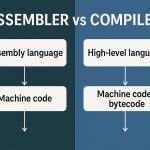
In lower-level programming, CPU instructions or virtual machine bytecode are encoded as binary opcodes.
Example (x86 Assembly):
MOV AX, 1May be encoded as:
B8 01 00Virtual machines like the Java Virtual Machine (JVM) or Python interpreter also encode logic as bytecode:
x = 10→ becomes Python bytecode: LOAD_CONST, STORE_NAME
Serialization and Data Encoding
Serialization is a form of encoding that converts in-memory objects into storable/transmittable formats.
| Format | Type | Human-readable | Use Cases |
|---|---|---|---|
| JSON | Text | Yes | APIs, config files |
| XML | Text | Yes | Data exchange, markup |
| Protobuf | Binary | No | Efficient communication |
| BSON | Binary | Partially | MongoDB storage |
| YAML | Text | Yes | Human-friendly configs |
Encoding vs Encryption vs Hashing vs Compression
| Concept | Purpose | Reversible? | Secure? | Example |
|---|---|---|---|---|
| Encoding | Convert data format | ✅ Yes | ❌ No | Base64, UTF-8 |
| Encryption | Secure data with a key | ✅ Yes | ✅ Yes | AES, RSA |
| Hashing | One-way signature | ❌ No | ✅ Partial | SHA-256, MD5 |
| Compression | Reduce size | ✅ Yes | ❌ No | GZIP, ZIP |
Don’t confuse these! Encoding is not a security mechanism, just a representation mechanism.
Encoding in Programming
Python
text = "café"
encoded = text.encode('utf-8')     # b'caf\xc3\xa9'
decoded = encoded.decode('utf-8')  # 'café'
JavaScript
const uri = "hello world";
const encoded = encodeURIComponent(uri);  // "hello%20world"
C#
byte[] bytes = Encoding.UTF8.GetBytes("hello");
string text = Encoding.UTF8.GetString(bytes);
Encoding Errors
When decoding goes wrong, you might see:
UnicodeDecodeError(Python)- Garbled characters (�)
- Malformed JSON
- Crashes in media players
Common causes:
- Mismatch between encoding and decoding format
- Corrupted transmission
- Truncated byte streams
Always specify encoding explicitly in file I/O and APIs.
Encoding in Web Development
Browsers rely on encoding to render pages correctly:
If missing, special characters (e.g., ñ, ü, ç) may display incorrectly.
Form submissions, AJAX requests, cookies, and URL paths are also encoded behind the scenes.
Encoding for Security (XSS/SQL Injection Prevention)
Encoding is used to escape unsafe characters before inserting them into HTML or SQL.
- HTML encoding:
<→<"→"
- SQL encoding (via ORM or prepared statements):
SELECT * FROM users WHERE name = ?Proper encoding helps avoid injection attacks by neutralizing malicious payloads.
Real-World Analogy
Imagine you want to send a letter to someone who speaks a different language. You translate the message using a common language (e.g., English). Encoding is just that: a shared way to represent and understand data, regardless of its original form.
Summary Table
| Aspect | Value |
|---|---|
| Definition | Transforming data into a standard format |
| Purpose | Compatibility, storage, transmission |
| Common Forms | Character, multimedia, base, bytecode |
| Reversibility | Yes (if decoding rules are known) |
| Use Cases | Text files, web, APIs, media, system programming |
| Common Errors | Mismatched formats, decoding failures |
Related Keywords
ASCII Encoding
Base64
Byte Order
Character Encoding
Codec
Data Serialization
Encoding Scheme
Instruction Set
Media Compression
Message Format
Percent Encoding
Serialization Format
Text Representation
Transmission Encoding
Unicode
URI Encoding
UTF-8
Video Codec
Virtual Machine Bytecode
XML and JSON