Description
An interpreter is a type of computer program that reads and executes code line by line or statement by statement, without first compiling the entire program into machine-level instructions. This contrasts with compilers, which translate code into a separate binary executable before it is run.
Interpreters are integral to many high-level programming languages, especially during development and debugging, due to their ability to provide immediate feedback and error information. Examples of languages traditionally interpreted include Python, JavaScript, Ruby, and PHP.
How Interpreters Work
The interpreter typically performs the following steps:
- Lexical Analysis: Tokenizes the source code into recognizable symbols.
- Parsing: Converts tokens into a syntax tree.
- Semantic Analysis: Ensures code follows language rules.
- Execution: Traverses the syntax tree and runs code directly.
This entire cycle happens during program execution, often repeatedly as new lines of code are encountered.
Interpreter vs Compiler
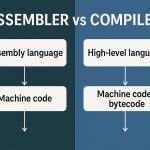
| Feature | Interpreter | Compiler |
|---|---|---|
| Execution | Line-by-line | Whole program |
| Output | No separate binary | Generates executable file |
| Speed | Slower (interprets during runtime) | Faster after compilation |
| Debugging | Easier, more immediate | Requires recompilation |
| Languages | Python, Ruby, JavaScript | C, C++, Go |
| Platform Dependency | Cross-platform | May be platform-specific |
Examples of Interpreters
- CPython – The default implementation of Python
- Node.js – JavaScript interpreter for server-side
- Ruby MRI – The standard Ruby interpreter
- PHP Engine – For interpreting PHP scripts
- REPL Environments – Found in Python, JavaScript, Lisp, etc.
Benefits of Using an Interpreter
- Portability: Code can often be run on any platform with the interpreter.
- Rapid Development: Changes can be tested quickly without recompilation.
- Dynamic Typing Support: Suited for languages with flexible runtime behavior.
- Ease of Learning: Great for beginners due to simplicity and immediate feedback.
Downsides
- Performance: Interpreted code is usually slower than compiled code.
- Security: Easier to deconstruct and analyze, increasing vulnerability.
- Distribution: Cannot be shared as a standalone executable without the interpreter.
Just-in-Time (JIT) Compilation
Some modern interpreters include JIT compilation, blending the benefits of both interpreters and compilers. The code is interpreted first, and frequently used parts are compiled into machine code at runtime for better performance.
Examples:
- V8 Engine (Chrome/Node.js)
- PyPy (for Python)
- HotSpot (Java Virtual Machine)
Interpreter Design and Architecture
A typical interpreter consists of:
- Tokenizer: Breaks code into tokens
- Parser: Constructs syntax trees
- Evaluator/Executor: Evaluates expressions and statements
Some interpreters are stack-based (e.g., Python), while others use registers or virtual machines internally (e.g., JavaScript VMs).
Interactive Use and REPL
Many interpreters offer a REPL (Read-Eval-Print Loop), allowing:
- Real-time execution of code
- Quick prototyping
- Educational demos
Example:
>>> print("Hello")
Hello
Role in Scripting
Interpreters are essential in scripting languages, which are often used for:
- Web development
- Automation
- Data processing
- Configuration and orchestration (e.g., shell scripts, Python scripts)
Use in Education
Interpreters lower the barrier to entry for beginners:
- No need for separate compile steps
- Instant feedback supports trial-and-error learning
Examples in Other Contexts
- Shell Interpreters: Like Bash, zsh, PowerShell
- Domain-Specific Languages (DSLs): e.g., SQL interpreters
- Educational Environments: Block-based languages (e.g., Scratch) often interpret scripts
Interpreter vs Virtual Machine
Though often confused, virtual machines (VMs) simulate entire hardware environments, while interpreters focus on executing code for specific languages. Some interpreters run on VMs (e.g., Python on JVM), blurring the lines.
Summary
An interpreter is a powerful tool that brings flexibility and ease of development to modern software engineering. While not always suitable for high-performance needs, interpreters are essential in scripting, education, rapid prototyping, and cross-platform environments. Understanding how they operate provides developers with the insight to choose the right tool or language implementation for their project.