What Is Machine Code?
Machine code is the most fundamental language of computers — a binary instruction set that a CPU can execute directly without any translation.
Each instruction is represented in a binary format (0s and 1s), which corresponds to specific operations like:
- Load
- Add
- Jump
- Store
- Compare
Unlike high-level languages (C, Python), machine code speaks natively to the processor.
1. How Machine Code Works
A CPU contains a Control Unit (CU) and an Arithmetic Logic Unit (ALU). The CU fetches instructions written in machine code from memory, decodes them, and sends signals to other components to execute them.
Every instruction in machine code includes:
- An opcode (operation code): what to do
- Operands: what data to use or where to store results
2. Instruction Format
Machine code instructions are typically fixed or variable in length, depending on the architecture.
Example: 8-bit Format
| Bits | Description |
|---|---|
| 4 bits | Opcode |
| 2 bits | Source Register |
| 2 bits | Destination Register |
A real instruction might look like: 1011 00 01 → Move data from R0 to R1
3. Examples of Machine Code (Different Architectures)
x86 (Intel):
B8 04 00 00 00 ; mov eax, 4ARM (32-bit):
E3A00001 ; mov r0, #1RISC-V:
00000000000100000000000010010011 ; addi x1, x0, 1These hexadecimal or binary values directly encode operations.
4. How Is Machine Code Generated?
High-level languages like C or Java are compiled into:
- Assembly code: human-readable instructions
- Machine code: binary instructions executed by the CPU
Compilation Steps:
- Source Code → (via Compiler) → Assembly
- Assembly → (via Assembler) → Object Files
- Object Files → (via Linker) → Machine Code Executable
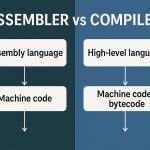
5. Assembly vs Machine Code
| Aspect | Assembly | Machine Code |
|---|---|---|
| Human-readable | Yes | No (binary/hex only) |
| CPU-executable | No (needs assembler) | Yes |
| Easier to debug | Yes | No |
| Portable | No | No |
Example (x86):
- Assembly:
mov eax, 1 - Machine Code:
B8 01 00 00 00
6. Executable File Formats
Machine code is stored in binary executable files such as:
- ELF (Linux)
- PE/EXE (Windows)
- Mach-O (macOS)
These files contain:
- Machine code
- Metadata (symbols, headers)
- Relocation tables
- Entry point (start instruction)
7. Why Different CPUs Have Different Machine Codes
Each CPU has a unique Instruction Set Architecture (ISA), such as:
- x86 / x86-64 (Intel, AMD)
- ARM (mobile)
- RISC-V (open-source)
- MIPS (legacy)
- PowerPC (Apple G4/G5 era)
A binary compiled for x86 won’t run on ARM because their machine instructions differ.
8. Machine Code and Operating Systems
Operating systems:
- Load machine code into memory
- Set up registers and stack
- Jump to entry point
- Handle system calls and interrupts via predefined machine instructions
System calls use software interrupts or sysenter/syscall instructions in machine code.
9. Reverse Engineering Machine Code
Tools like disassemblers (e.g., objdump, IDA Pro, Ghidra) convert machine code back into assembly.
This is used for:
- Malware analysis
- Security auditing
- Software cracking (illegal)
- Debugging
10. Machine Code and Security
Machine code is the final frontier for:
- Buffer overflows
- Code injection
- Return-oriented programming (ROP)
Security professionals often analyze machine code to detect vulnerabilities at the binary level.
11. Performance Implications
Because machine code is:
- Pre-optimized by compilers
- Free from abstraction overhead
- Targeted for specific hardware
…it executes with maximum efficiency. This is why critical components (kernels, drivers, encryption) are written in C and compiled directly.
12. Embedded Systems and Machine Code
In embedded programming, developers often:
- Write critical parts in assembly
- Embed direct machine code using
.bytedirectives - Flash binaries directly to memory chips
Microcontrollers like AVR or ARM Cortex-M run code without an OS, executing raw machine instructions.
13. Fun Fact: Machine Code in Hex Editors
You can open .exe, .bin, or .elf files in a hex editor and directly see:
- Opcodes
- Magic numbers
- Section headers
- Embedded strings
Example:
B8 01 00 00 00 CD 80 → mov eax, 1; int 0x80 (exit syscall in Linux)Summary
| Concept | Description |
|---|---|
| Machine Code | Binary code executed directly by CPU |
| Created by | Compiler + Assembler + Linker |
| Input for | CPU, microcontrollers, VMs |
| Architecture-Specific? | Yes (differs for x86, ARM, etc.) |
| Readable by Humans? | No (needs disassembler) |
| Performance | Maximum possible |
| Security Concerns | High (buffer overflows, exploits) |
| Debugging Tools | GDB, objdump, hex editors, disassemblers |
Machine code is pure power — the distilled essence of computation, stripped of abstraction, ready to run at full speed.
Related Keywords
- Instruction Set Architecture (ISA)
- Assembly Language
- Compiler
- Assembler
- Linker
- Opcode
- Binary Executable
- Disassembler
- ELF / EXE / Mach-O
- Object File
- Reverse Engineering
- CPU Registers
- Fetch-Decode-Execute
- System Call
- Instruction Pointer (IP)
- Hexadecimal Representation
- Embedded Systems
- RISC vs CISC
- x86, ARM, RISC-V