What Is Memory Allocation?
Memory allocation is the process of reserving a portion of a computer’s memory for storing variables, data structures, objects, or executable code during the execution of a program.
At runtime, programs need memory for:
- Storing variables and constants
- Creating dynamic data structures (arrays, objects, trees)
- Calling functions (and preserving state in recursion)
- Loading code into memory
It’s the backstage work of every software — invisible to users, but essential for everything to work correctly
1. Why Memory Allocation Matters
| Concern | Role of Allocation |
|---|---|
| Performance | Avoid frequent or wasteful allocations |
| Stability | Prevent memory overuse (leaks) |
| Security | Prevent buffer overflows and undefined behavior |
| Scalability | Efficient use of available RAM across threads/processes |
2. Types of Memory Allocation
a) Static Allocation
- Memory size is determined at compile time
- Allocation happens in global or static memory
- Cannot grow or shrink during runtime
C Example:
int arr[10]; // size fixed at compile timeUsed for:
- Global variables
- Static variables
- Constants
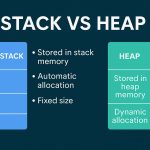
b) Stack Allocation
- Happens in LIFO (Last-In-First-Out) manner
- Fast, but limited in size
- Deallocated automatically when function exits
Example:
void func() {
    int x = 42; // allocated on stack
}
Features:
- No manual management needed
- Ideal for short-lived data (local variables, function calls)
- Prone to stack overflow in deep recursion
c) Heap Allocation (Dynamic Memory)
- Done at runtime using pointers
- Memory stays allocated until explicitly freed (manual) or garbage-collected (automatic)
Examples:
int* p = malloc(sizeof(int)); // C
int* p = new int;             // C++
Or in Python:
x = [1, 2, 3] # allocated on heapUse cases:
- Dynamic arrays
- Objects
- Long-lived data
- Variable-sized data structures (trees, graphs)
3. Memory Layout of a Running Program
| Segment | Purpose |
|---|---|
| Text (code) | Contains executable instructions |
| Data | Global/static variables |
| Heap | Dynamically allocated memory (grows upward) |
| Stack | Function call data (grows downward) |
Illustration:
Low Address
-------------
|  Text     |
|  Data     |
|  Heap ↑   |
|          |
|  Stack ↓ |
-------------
High Address
4. Manual vs Automatic Allocation
Manual (e.g., C/C++)
- You allocate and deallocate explicitly
int* p = malloc(sizeof(int));
free(p);
✅ More control
❌ Prone to memory leaks, dangling pointers, double free
Automatic (e.g., Python, Java)
- Managed by garbage collector
- Tracks object reachability and cleans up unused memory
String s = "Hello"; // no manual allocation or deallocation✅ Safer, easier
❌ Slower due to background processes
❌ Less predictable memory behavior
5. Common Allocation Functions & APIs
| Language | Allocation | Deallocation |
|---|---|---|
| C | malloc(), calloc(), realloc() | free() |
| C++ | new / new[] | delete / delete[] |
| Java | new keyword | automatic (GC) |
| Python | object = ... | automatic (GC) |
| Rust | Box::new() / smart pointers | automatic (ownership model) |
6. Allocation Strategies
a) First Fit
- Use the first available block of sufficient size
- Fast, but leads to fragmentation
b) Best Fit
- Find the smallest suitable block
- Reduces wasted space, but slower
c) Buddy System
- Splits memory into powers of 2
- Efficient for managing varying-sized allocations
d) Slab Allocation (Kernel)
- Common in operating systems
- Pools memory by object type (slabs)
7. Garbage Collection (GC)
Languages like Java, Python, Go, JavaScript use GC to manage memory.
GC Strategies
| Strategy | Description |
|---|---|
| Reference Counting | Tracks how many references point to an object |
| Mark and Sweep | Marks reachable objects, sweeps others |
| Generational GC | Splits heap by object age |
| Tracing GC | Builds graph of object references |
GC pros:
- Prevents leaks
- Simplifies code
GC cons:
- CPU overhead
- Non-deterministic behavior (can’t predict when memory will be freed)
8. Memory Leaks & Fragmentation
Memory Leak:
Allocated memory that is never freed, leading to RAM consumption over time.
void leak() {
    int* p = malloc(100);
    // forgot to free(p)
}
Fragmentation:
Memory is available but scattered, so large requests fail despite total space being sufficient.
| Type | Description |
|---|---|
| External | Free memory is split into unusable chunks |
| Internal | Allocated blocks waste space due to alignment |
9. Tools for Memory Analysis
| Tool | Use Case |
|---|---|
| Valgrind | Detects leaks in C/C++ |
| gperftools | Google Performance Tools |
| ASan | AddressSanitizer |
| Memory Profiler (Python) | Track memory usage in Python |
| JVisualVM / YourKit | Java memory inspection |
| Heaptrack | Heap allocations in Linux apps |
10. Allocation in Modern Systems
OS-Level Memory Management
Operating systems allocate memory in pages (e.g., 4KB units), and map them to physical RAM using page tables. Processes are sandboxed via virtual memory, preventing interference.
MMU & Virtual Memory
- MMU (Memory Management Unit) translates virtual addresses to physical ones
- Supports paging, protection, and swapping
Memory Allocation in Multithreading
Multithreaded programs must coordinate access to shared memory:
- Use locks to prevent race conditions
- Use thread-local storage (TLS) to reduce contention
- Consider lock-free data structures for performance
Memory Pools & Arenas
For high-performance systems, custom allocators are often used:
- Preallocate large chunks (pools)
- Avoid system calls like
malloc()frequently - Used in games, embedded systems, and real-time apps
Summary
Memory allocation is at the core of every program, whether high-level or low-level. Understanding how memory is requested, used, and released helps developers write safer, faster, and more efficient software.
From stack frames to garbage collectors, from kernel slab allocators to JavaScript’s heap, memory allocation remains one of the most powerful — and complex — responsibilities of modern computing.
“Master the heap, respect the stack, and your programs shall run like rivers.”
Related Keywords
- Heap
- Stack
- malloc
- free
- new/delete
- Garbage Collection
- Reference Counting
- Memory Leak
- Fragmentation
- Page Table
- Memory Pool
- Slab Allocator
- First Fit / Best Fit
- Stack Overflow
- Virtual Memory
- MMU
- Smart Pointers
- Thread-local Storage
- Valgrind
- Memory Profiler