Description
In computer science, a program is a set of structured instructions written in a programming language that tells a computer what to do. It is a static, non-executing artifact — usually stored on disk — that becomes dynamic and actionable only when it is run as a process. A program defines logic, control flow, and data manipulation in a way that a machine can interpret and execute, often with the help of compilers or interpreters.
From simple scripts that automate tasks to large-scale applications that power operating systems and web services, every piece of digital functionality begins with a program.
How It Works
At a foundational level, a program serves as a bridge between human intent and machine action. It provides the instructions — often written in high-level code like Python, Java, or C — which must be translated into machine-level instructions via compilation or interpretation.
Lifecycle of a Program
- Write: The programmer writes source code.
- Compile or Interpret: The code is translated into machine-executable form.
- Load: The translated instructions are loaded into memory.
- Execute: The program becomes a running process.
- Terminate: The program completes its task and releases resources.
The boundary between “program” and “process” lies precisely at the moment of execution. Until a program is run, it remains inert — no CPU cycles, no memory allocation, no system interaction.
Program vs Process
Though often used interchangeably in casual conversation, program and process are distinct.
| Concept | Program | Process |
|---|---|---|
| Nature | Static code | Dynamic execution |
| Stored In | Disk (file system) | Memory (RAM) |
| Identity | File path | Process ID (PID) |
| Shared? | Can be opened multiple times | Unique instance per execution |
You can have multiple processes created from the same program — each executing independently.
Types of Programs
1. System Programs
Low-level programs that interact with the operating system and hardware.
- Device drivers
- Kernel modules
- Shell utilities
2. Application Programs
Designed for end-users to perform specific tasks.
- Word processors
- Browsers
- Media players
3. Utility Programs
Support tasks like backup, compression, file management.
- Disk Defragmenters
- Antivirus software
- File compressors
4. Scripts and Batch Programs
Lightweight, often interpreted programs for automation.
- Shell scripts (
.sh) - PowerShell scripts
- Python or JavaScript scripts
Structure of a Program
Programs are typically divided into several sections:
- Declarations – define variables, constants, types
- Functions – reusable code blocks
- Main Routine – the entry point of the program
- Control Flow – conditional logic (
if,for,while) - I/O Handling – input/output with user, files, or network
- Error Handling – try/catch or conditional checks
Example: Python Program
def greet(name):
    print(f"Hello, {name}!")

if __name__ == "__main__":
    user = input("Enter your name: ")
    greet(user)
Example: C Program
#include <stdio.h>

int main() {
    printf("Hello, world!\n");
    return 0;
}
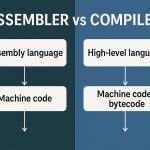
Compilation vs Interpretation
How a program turns into executable behavior depends on the paradigm:
| Method | Description | Languages |
|---|---|---|
| Compiled | Entire code is translated into machine code before execution | C, C++, Rust |
| Interpreted | Code is read and executed line-by-line at runtime | Python, Ruby, JavaScript |
| Hybrid | Compiled to intermediate bytecode, then interpreted | Java (JVM), C# (.NET CLR) |
Compiled programs are generally faster but less flexible. Interpreted programs are easier to debug and modify on the fly.
High-Level vs Low-Level Programs
- High-Level: Abstracted from machine architecture (e.g., Python, Java)
- Low-Level: Closer to hardware, more control (e.g., Assembly, C)
High-level languages allow rapid development and cross-platform compatibility, while low-level ones offer performance and control.
Program Execution Flow
The flow of a typical program might look like this:
Start → Input → Processing → Decision → Output → EndControl structures direct this flow:
if / else: decision-makingfor / while: iterationtry / except: error handling
Real-World Analogy
Imagine a program as a recipe:
- The recipe (program) contains instructions.
- The cook (CPU) reads the recipe step-by-step.
- The kitchen (memory, storage) provides resources.
- When the cook starts cooking (execution), the recipe becomes a process.
You can run the same recipe multiple times, resulting in multiple meals (processes).
Software vs Program
While often used interchangeably, there is a subtle distinction:
- A program is a single executable unit.
- Software is a broader term that may include multiple programs, libraries, documentation, and configuration files.
For example, Microsoft Word is software that contains multiple programs for editing, spell-checking, printing, etc.
Security Considerations
Programs can be:
- Malicious (malware, ransomware)
- Vulnerable (contain bugs that can be exploited)
- Sandboxed (executed in restricted environments)
Good practices include:
- Code signing
- Input validation
- Dependency management
- Principle of least privilege
Development Lifecycle
Programs go through a software development life cycle (SDLC):
- Requirements Gathering
- Design
- Implementation (Coding)
- Testing
- Deployment
- Maintenance
Tools such as version control (e.g., Git), CI/CD pipelines, and IDEs support this cycle.
Program Files and Extensions
Common program file extensions:
| Extension | Description |
|---|---|
.exe | Windows executable |
.app | macOS application |
.sh | Unix shell script |
.py | Python script |
.class | Compiled Java bytecode |
.dll | Dynamic link library |
Program Optimization
Techniques to improve performance:
- Loop unrolling
- Inlining functions
- Memory caching
- Parallelization
- Compiler optimizations (-O2, -O3 in GCC)
Profilers and static analyzers help identify bottlenecks.
Misconceptions
- “A program is the same as software” → Not always. Software includes more than just programs.
- “Only .exe files are programs” → Many programs exist in other formats and platforms (e.g.,
.out,.bin,.py). - “A program does everything alone” → Most modern programs rely on libraries, frameworks, and the operating system.
Related Terms
- Process
- Thread
- Compiler
- Interpreter
- Source Code
- Executable
- Script
- Function
- Main Method
- Algorithm
- Application
- Software
- System Call
- Binary
- Debugger