Description
A Stackless Function refers to a function that does not rely on the traditional call stack to preserve its execution context during suspension or recursion. Instead, it maintains its state explicitly, often using heap-allocated state machines or register-based execution, allowing advanced control flow patterns such as non-blocking recursion, tail-call optimization, and asynchronous continuations.
Stackless functions are most commonly used in environments where:
- Deep recursion needs to avoid stack overflows,
- Coroutines or generators suspend/resume execution repeatedly,
- Concurrency and async workflows must operate efficiently without growing the call stack.
Key Characteristics
| Feature | Description |
|---|---|
| No Stack Growth | Doesn’t rely on call stack for each function invocation |
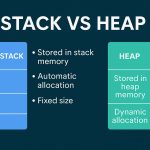
| Heap-Based State | Stores function context in heap instead of the stack |
| Suspension-Friendly | Ideal for async, generator, or coroutine-based programming |
| Efficient Resumption | Execution can resume from where it left off without stack unwinding |
| Tail-Call Optimizable | Supports infinite tail-recursive patterns |
Real-World Use Cases
| Use Case | Benefit of Stackless Functions |
|---|---|
| Coroutines (e.g., Kotlin) | Avoids stack bloat from suspending/resuming coroutines |
| Async State Machines | Uses minimal memory even during complex async flows |
| Functional Programming | Enables safe recursion in languages like Scala or Haskell |
| Embedded Systems | Saves memory in low-stack hardware environments |
Stack vs Stackless Execution
| Feature | Stack-Based Function | Stackless Function |
|---|---|---|
| Call Context | Stored in program stack | Stored in custom heap/state machine |
| Recursion Depth | Limited by stack size | Potentially unlimited (if tail-recursive) |
| Performance | Faster per call, but limited by stack | Slight overhead, better for deep execution |
| Suspension Support | Requires complex transformations | Naturally supports yield/suspend |
Stackless Coroutines
Languages like Kotlin, Python, and JavaScript (ES6+) use stackless coroutines, where:
- Each coroutine maintains its state in a heap-allocated structure.
- Execution is resumed using a state machine rather than relying on the call stack.
This allows suspending and resuming thousands of coroutines without causing stack overflow.
Example: Stack-Based vs Stackless Recursion
Stack-Based Recursion (Python)
def factorial(n):
    if n == 0:
        return 1
    return n * factorial(n - 1)
For large n, this will hit RecursionError.
Stackless Recursion (Trampoline Pattern)
def factorial(n):
    def loop(n, acc):
        while n > 0:
            acc *= n
            n -= 1
        return acc
    return loop(n, 1)
This avoids deep recursive calls by using a loop (simulated stackless behavior).
Trampolines and Tail Call Optimization
A trampoline is a function that repeatedly calls returned functions without growing the stack.
function trampoline(fn) {
    while (typeof fn === 'function') {
        fn = fn();
    }
    return fn;
}
Tail-Call Optimization (TCO) allows recursive functions to reuse their current stack frame, effectively achieving stackless behavior:
function factorial(n, acc = 1) {
    if (n === 0) return acc;
    return factorial(n - 1, acc * n); // can be optimized if TCO supported
}Note: TCO is supported in some functional languages (Scheme, Haskell), but not universally in JavaScript or Python.
Stackless Python
Stackless Python is a Python variant that offers microthreads and stackless coroutines. Features include:
- Tasklets: lightweight threads
- Channels: message passing between tasklets
- No dependence on the C call stack
It allows for massive concurrency in Python without OS threads or recursion limits.
Benefits
| Advantage | Explanation |
|---|---|
| Memory Efficiency | Uses heap space predictably rather than risking stack overflow |
| Safe Deep Recursion | Supports millions of recursive steps if written in stackless form |
| Suspend/Resume Capability | Enables non-blocking async workflows with precise state control |
| Cross-Platform Portability | Less reliance on hardware or OS stack characteristics |
| Ideal for Functional Programming | Encourages purity and recursion without traditional limits |
Limitations
| Limitation | Description |
|---|---|
| Performance Overhead | Slightly slower than stack-based calls due to state management |
| Manual Management | Requires developers or compiler to handle state machine transformations |
| Tooling Complexity | Debugging state machines or trampolines can be harder |
| Limited Language Support | Native stackless support is rare in mainstream languages |
Programming Languages and Environments
| Language | Stackless Support Type |
|---|---|
| Python (async) | Stackless coroutines with async def and await |
| Kotlin | Compiler transforms suspend functions to state machines |
| JavaScript (Generators) | Implements stackless iteration with yield |
| Haskell | Functional recursion via tail-call optimization |
| Lua | Coroutine-based with explicit stackless behavior |
| Stackless Python | Native tasklets and microthreading model |
Implementation Approaches
- State Machine Transformation: Compiler rewrites function into a state-tracking structure.
- Trampolining: Returns next steps as functions until computation is complete.
- Heap Context Storage: Stores intermediate variables and positions on the heap instead of the stack.
- Tail-Call Elimination: Reuses the same frame for self-recursive calls when it’s the last operation.
Comparison Table
| Technique | Stackless? | Description |
|---|---|---|
| Recursion | ❌ | Traditional stack-consuming method |
| Tail-Call Optimization | ✅ | Avoids stack use in tail-recursive functions |
| Coroutine (Python/Kotlin) | ✅ | Stackless due to async state machine handling |
| Generator Function | ✅ | Maintains state without stack use via yield |
| Trampoline Function | ✅ | Emulates recursion without stack frames |
Related Concepts
| Concept | Connection |
|---|---|
| Coroutine | Often implemented as stackless structures |
| State Machine | Underlying model for most stackless function transformations |
| Tail Call Optimization | Enables infinite recursion without stack growth |
| Heap Allocation | Stores execution state outside of call stack |
| Trampolining | Simulates recursion using looped function returns |
| Stack Overflow | Stackless design helps prevent this in deep function chains |
Related Keywords
- Async Generator
- Call Stack
- Continuation Passing
- Coroutine Resumption
- Heap Frame
- Non-blocking Recursion
- State Machine Transformation
- Suspension Point
- Tail Call
- Trampolining