What Is Supervised Learning?
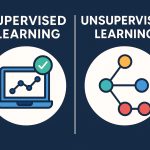
Supervised Learning is a type of machine learning where a model is trained on a labeled dataset, meaning that each input has a known, correct output. The goal is for the algorithm to learn the relationship between inputs and outputs so it can predict the output for new, unseen inputs.
Think of it as a student learning from a teacher: every answer is known during training.
1. Key Concepts
| Term | Description |
|---|---|
| Input (X) | Features or independent variables |
| Output (Y) | Labels or dependent variables |
| Model | The mathematical function that maps inputs to outputs |
| Training Data | Known examples used to train the model |
| Testing Data | Unseen examples used to evaluate model performance |
| Loss Function | Measures the difference between predicted and actual outputs |
The model iteratively updates itself to minimize the loss function, improving its predictions.
2. How Supervised Learning Works
Step-by-Step Process:
- Collect Data: Gather labeled data samples
(X, Y) - Split Data: Divide into training and testing (e.g., 80/20 split)
- Choose Algorithm: Select a suitable model (e.g., Linear Regression)
- Train Model: Feed training data into the model and adjust parameters
- Validate: Evaluate model on the test set to measure accuracy
- Deploy: Use the trained model to make predictions on new data
3. Types of Supervised Learning Problems
a) Classification
- Predicts discrete labels
- Example: Is this email spam or not?
Popular Algorithms:
- Logistic Regression
- Support Vector Machines (SVM)
- Decision Trees
- Random Forest
- Naive Bayes
- K-Nearest Neighbors (KNN)
b) Regression
- Predicts continuous values
- Example: Predict the price of a house based on its size and location.
Popular Algorithms:
- Linear Regression
- Ridge/Lasso Regression
- Decision Trees for Regression
- SVR (Support Vector Regression)
- Gradient Boosting Regressors
4. Real-World Examples
| Use Case | Type | Description |
|---|---|---|
| Email filtering | Classification | Spam vs non-spam |
| Credit scoring | Classification | Approve or reject loan |
| Stock price prediction | Regression | Forecast future prices |
| Medical diagnosis | Classification | Classify disease types |
| Sales forecasting | Regression | Predict future sales |
| Image recognition | Classification | Is this a dog, cat, or car? |
5. Sample Python Code (Classification: Logistic Regression)
Python:
from sklearn.datasets import load_iris
from sklearn.linear_model import LogisticRegression
from sklearn.model_selection import train_test_split
from sklearn.metrics import accuracy_score

# Load data
data = load_iris()
X = data.data
y = data.target

# Train/test split
X_train, X_test, y_train, y_test = train_test_split(X, y, test_size=0.2)

# Train model
model = LogisticRegression(max_iter=200)
model.fit(X_train, y_train)

# Predict
y_pred = model.predict(X_test)

# Evaluate
print("Accuracy:", accuracy_score(y_test, y_pred))
6. Evaluation Metrics
For Classification:
- Accuracy:
(Correct Predictions) / (Total Predictions) - Precision, Recall, F1-Score
- Confusion Matrix
- ROC-AUC Score
For Regression:
- Mean Absolute Error (MAE)
- Mean Squared Error (MSE)
- Root Mean Squared Error (RMSE)
- R² Score (Coefficient of determination)
7. Common Algorithms
| Algorithm | Type | Characteristics |
|---|---|---|
| Linear Regression | Regression | Simple, interpretable |
| Logistic Regression | Classification | Probabilistic output |
| Decision Tree | Both | Easy to visualize |
| Random Forest | Both | Ensemble of trees, robust |
| KNN | Both | Memory-based, no training phase |
| SVM | Both | Powerful for complex boundaries |
| Naive Bayes | Classification | Fast and good with text data |
| Neural Networks | Both | Scalable, nonlinear modeling |
8. Advantages of Supervised Learning
| Advantage | Description |
|---|---|
| Straightforward | Easier to understand and implement |
| Effective for known goals | Works well when labels are available |
| Predictive power | Strong generalization for many applications |
| Widely supported | Tools like scikit-learn, TensorFlow, and PyTorch simplify use |
9. Limitations of Supervised Learning
| Limitation | Impact |
|---|---|
| Requires labeled data | Costly and time-consuming to collect |
| Overfitting | Learns training data too well, poor generalization |
| Bias in training data | Leads to discriminatory outcomes |
| Not good for discovery | Can’t find unknown patterns like unsupervised learning |
| Scalability issues | With large datasets or many labels, training time increases |
10. Supervised vs. Unsupervised vs. Reinforcement Learning
| Feature | Supervised | Unsupervised | Reinforcement |
|---|---|---|---|
| Data Labeling | Required | Not needed | Rewards and penalties |
| Goal | Prediction | Pattern discovery | Action-based learning |
| Example | Spam detection | Customer segmentation | Game-playing AI |
| Popular Algorithms | SVM, RF, NN | K-Means, PCA | Q-Learning, DQN |
11. Best Practices
- Clean your data: Missing or incorrect labels degrade performance
- Balance your classes: Prevents bias toward majority class
- Use cross-validation: Avoid overfitting
- Feature engineering: Choose or create meaningful features
- Regularization: Prevents over-complex models (e.g., L1/L2)
- Hyperparameter tuning: Use grid search or random search
Summary
Supervised Learning is the foundation of many practical AI systems today. Whether it’s diagnosing diseases, recommending products, or predicting prices, it empowers models to learn from the past to make predictions about the future. While it demands labeled data and thoughtful tuning, its predictive strength and real-world success make it an essential tool in the AI toolkit.
“Supervised learning teaches machines to see patterns — and act with confidence.”
Related Keywords
- Machine Learning
- Classification
- Regression
- Training Data
- Labeling
- Loss Function
- Neural Network
- Decision Tree
- Overfitting
- Feature Engineering
- Model Evaluation
- Cross-Validation
- Ensemble Methods
- Logistic Regression
- Bias-Variance Tradeoff
- Regularization
- Test Set
- Prediction Accuracy
- Gradient Descent
- Model Tuning