Description
A variable is a named storage location in a program that holds a value which can change during the execution of the program. Variables are fundamental to programming and computer science because they allow developers to store, retrieve, and manipulate data dynamically.
In most programming languages, a variable has:
- A name (or identifier)
- A type (depending on the language, this may be explicit or inferred)
- A value (which can be updated or reassigned)
Variables enable everything from simple arithmetic to complex algorithms, and are essential for control flow, data processing, memory management, and interaction with users and external systems.
Importance in Computer Science
Variables are the core building blocks of all programming paradigms, including:
- Imperative programming: where variables reflect state changes over time.
- Object-oriented programming: where variables become fields or properties of classes.
- Functional programming: where immutability of variables is often preferred.
- Declarative programming: where variables bind data rather than control flow.
They also play a key role in:
- Data structures and algorithms
- Compiler design
- Memory management
- Operating systems
- Artificial intelligence and machine learning
- Databases and query languages
How It Works
Variable Declaration
Depending on the language, variables may need to be declared with a specific data type.
Examples:
In statically typed languages (like Java):
int age = 30;
String name = "Alice";
In dynamically typed languages (like Python):
age = 30
name = "Alice"
Variable Assignment
Assignment uses the = operator in most languages. You can update a variable’s value:
x = 10
x = x + 5  # Now x is 15
Memory Model
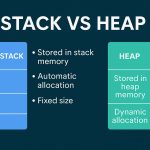
When a variable is declared, memory is allocated. The name serves as a reference (in high-level languages), and the value is stored at an address.
In low-level languages like C:
int x = 5;
// 'x' points to a memory address where value 5 is stored
Key Concepts and Components
| Term | Description |
|---|---|
| Identifier | The name of the variable (e.g., total, userName) |
| Data Type | The kind of value the variable holds (e.g., int, string, float) |
| Scope | Where in the code the variable can be accessed |
| Lifetime | The duration a variable exists in memory |
| Initialization | Assigning a value to a variable at creation |
| Assignment | Updating the value of a variable |
| Mutable/Immutable | Whether a variable’s value can be changed |
| Global/Local Variables | Scope across the entire program vs. within a function or block |
| Constants | Immutable variables, often declared with const, final, or readonly |
📌 Example: Scope in JavaScript
let globalVar = "I'm global";

function testScope() {
  let localVar = "I'm local";
  console.log(globalVar); // accessible
  console.log(localVar);  // accessible
}

console.log(globalVar); // accessible
console.log(localVar);  // ERROR: not defined
Real-World Applications
| Domain | Variable Use |
|---|---|
| Web Development | Store user inputs, state, DOM references |
| Data Science | Hold datasets, parameters, model predictions |
| Game Development | Track player position, score, inventory |
| Embedded Systems | Store sensor readings, control signals |
| Databases | Use session variables, stored procedure vars |
| AI and ML | Variables represent weights, biases, gradients |
Challenges and Limitations
| Challenge | Explanation |
|---|---|
| Uninitialized Variables | Using a variable before assigning a value can cause errors |
| Name Collisions | Reusing variable names in overlapping scopes can cause bugs |
| Memory Leaks | Variables not cleared from memory may consume resources |
| Mutable State Bugs | Unexpected value changes in shared variables |
| Shadowing | Inner scope variable masks outer scope variable |
| Global Pollution | Overuse of global variables leads to hard-to-maintain code |
Comparison with Related Concepts
| Concept | Difference |
|---|---|
| Constant | Cannot be reassigned after initialization |
| Pointer | Stores memory addresses, not direct values |
| Reference | Refers to another variable or memory location |
| Parameter | Variable passed into a function |
| Field/Property | Variable tied to a class/object |
| Environment Variable | OS-level variable affecting process behavior |
| Register | Low-level hardware location used as a variable in assembly languages |
Best Practices
- Use descriptive names (
userEmail>x) - Initialize variables before use
- Limit scope to where the variable is needed
- Prefer immutability when possible (especially in functional programming)
- Avoid global variables in large applications
- Use constants for fixed values
- Be aware of type conversions and coercions in dynamic languages
Future Trends
- Type Inference & Static Analysis
- Languages like TypeScript, Rust, and Kotlin improve variable handling via smart type systems
- Immutable-by-Default Paradigms
- Functional languages and modern architectures discourage mutation
- Scoped Variables in WebAssembly
- WebAssembly and low-level platforms treat variables as registers with strict scope
- Variable Tracking with AI
- IDEs suggest better naming and scope detection using AI-based tools
- Advanced Debugging
- Visual tools (e.g., Chrome DevTools, VSCode) to trace variable state over time
Conclusion
Variables are the essence of programming logic. They enable computation, control flow, memory management, data modeling, and dynamic behavior in every software system. Understanding how variables work—across scopes, types, lifetimes, and languages—is fundamental to writing robust, readable, and efficient code.
From a single flag to a massive multi-dimensional array, variables give structure to logic and make computers programmable.
Related Terms
- Identifier
- Assignment
- Scope
- Data Type
- Constant
- Global Variable
- Local Variable
- Parameter
- Reference
- Pointer
- Immutable
- Dynamic Typing
- Static Typing
- Garbage Collection
- Stack / Heap
- Memory Allocation
- Shadowing
- Closure
- Environment Variable