Description
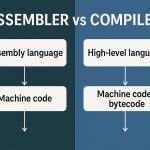
Compilation is the process of translating source code written in a high-level programming language (like C, C++, or Java) into machine code that a computer’s processor can execute. This transformation is performed by a specialized software tool called a compiler.
The goal of compilation is to bridge the gap between human-readable programming instructions and the binary-level language that computer hardware understands. A successful compilation yields an executable binary file or intermediate bytecode, depending on the language and platform.
Why Compilation Matters
Unlike interpreted languages (e.g., Python or JavaScript), compiled languages offer:
- Better performance: Compiled code runs directly on hardware.
- Early error detection: Many errors are caught before runtime.
- Optimization: Compilers can optimize code for speed and size.
- Obfuscation: Compiled code is harder to reverse-engineer.
The Compilation Process
The process of compilation typically includes several well-defined phases:
1. Lexical Analysis
- Breaks source code into tokens (keywords, operators, literals).
- Removes comments and unnecessary whitespace.
2. Syntax Analysis (Parsing)
- Checks whether the code structure adheres to grammar rules.
- Produces a parse tree or abstract syntax tree (AST).
3. Semantic Analysis
- Validates data types, variable scopes, and function signatures.
- Detects logical inconsistencies or misuse of constructs.
4. Intermediate Code Generation
- Converts the AST into an intermediate representation (IR).
- Facilitates machine independence and optimization.
5. Optimization
- Refines the IR to improve runtime performance.
- Examples: dead code elimination, loop unrolling, inlining.
6. Code Generation
- Converts the IR into machine code or bytecode.
- Targets specific processor architecture (e.g., x86, ARM).
7. Code Linking and Assembly
- Combines multiple object files and libraries.
- Produces a single executable binary or shared object.
Compilation Example (C Language)
#include

int main() {
    printf("Hello, world!\n");
    return 0;
}
Compilation Command (GCC):
gcc -o hello hello.c
./hello
Output:
Hello, world!This demonstrates how a .c file is compiled into an executable named hello.
Compiler Types
| Compiler Type | Description |
|---|---|
| Ahead-of-Time (AOT) | Compilation happens before execution; results in a binary file. |
| Just-In-Time (JIT) | Compilation happens during runtime; balances speed and flexibility. |
| Cross Compiler | Produces binaries for platforms different from the compiler’s host. |
| Source-to-Source | Translates code from one language to another. |
Common Compilers by Language
| Language | Compiler(s) |
|---|---|
| C/C++ | GCC, Clang, MSVC |
| Java | javac (compiles to bytecode) |
| Rust | rustc |
| Go | go build |
| Swift | swiftc |
| Haskell | GHC |
Interpreted vs. Compiled Languages
| Feature | Compiled Languages | Interpreted Languages |
|---|---|---|
| Execution Speed | Faster (pre-translated) | Slower (line-by-line execution) |
| Error Detection | At compile-time | At runtime |
| Portability | Less portable (machine-specific) | More portable |
| Debugging | Harder | Easier |
| Examples | C, C++, Rust, Go | Python, Ruby, JavaScript |
Bytecode and Virtual Machines
Some languages (e.g., Java, C#) compile to bytecode, which runs on a virtual machine.
Example:
# Java compilation
javac HelloWorld.java

# Execution via JVM
java HelloWorld
Bytecode allows platform independence — “write once, run anywhere.”
Compiler Optimization Techniques
| Optimization | Description |
|---|---|
| Constant Folding | Replaces expressions with constant results. |
| Loop Unrolling | Reduces loop control overhead. |
| Dead Code Elimination | Removes code that never executes. |
| Inlining | Embeds function calls directly into caller code. |
Example:
Original:
int square(int x) { return x * x; }
int main() { return square(4); }
Optimized:
int main() { return 4 * 4; }Error Handling in Compilation
| Error Type | Detected During | Example |
|---|---|---|
| Syntax Error | Parsing | Missing semicolon |
| Semantic Error | Semantic Analysis | Type mismatch or undefined variable |
| Linking Error | Linking | Undefined reference to external lib |
Toolchains and Build Systems
Compiling a large codebase typically involves toolchains and build automation tools.
Examples:
| Language | Build Tool |
|---|---|
| C/C++ | Make, CMake, Ninja |
| Java | Maven, Gradle |
| Rust | Cargo |
| Go | go build, go run |
# Building a C++ project with CMake
cmake .
make
Transpilation
Transpilation is a form of compilation between source languages. For example:
- TypeScript → JavaScript
- Babel (ES6) → ES5
- Sass → CSS
This is especially common in frontend development.
Compilation in Modern Toolchains
With DevOps and CI/CD pipelines, compilation has become part of automated workflows.
Example (GitHub Actions):
name: Build C App

on: [push]

jobs:
  build:
    runs-on: ubuntu-latest
    steps:
    - uses: actions/checkout@v2
    - run: gcc -o hello hello.c
Security Considerations
- Ensure trusted compilers to avoid malicious injections (e.g., Ken Thompson’s “Trusting Trust”).
- Use reproducible builds to guarantee binary integrity.
- Compile with security flags:
gcc -fstack-protector-strong -D_FORTIFY_SOURCE=2 -O2 -Wformat -Werror=format-security hello.c -o helloCompilation Errors and Warnings
A robust compiler issues warnings for suspicious constructs and errors for violations.
Example (GCC):
int main() {
    int x;
    printf("%d\n", x);  // warning: ‘x’ is used uninitialized
    return 0;
}
Related Terms
Conclusion
Compilation is a foundational concept in computer science, enabling the execution of human-written code on physical machines. It encapsulates not only translation but also validation, optimization, and packaging of programs.
As programming languages, platforms, and architectures evolve, so do the compilers that serve them. Understanding compilation helps developers write more efficient, reliable, and portable code, and enables insight into performance tuning, debugging, and software security.